

I’ve watched businesses spend £60,000 before their first marketing campaign even launches. That’s why outsourced marketing (done properly) is often the fastest way to build a real marketing function without the overhead.
Here’s how it happens: You hire a marketing manager at £50,000. Add recruitment fees at 20% of salary, that’s another £10,000 straight to the agency. Then National Insurance, pension contributions, equipment, and office space push the real cost closer to £65,000.
And you haven’t run a single ad yet.
The average UK marketing manager salary sits between £45,000-£55,000, but employer National Insurance increased to 15% from April 2025. Benefits, equipment, and workspace add 20-30% to base salary costs. The real number rarely stays at “£50k.”
If the business can handle the financial strain, it’ll be months before seeing positive ROI. That person needs to learn your business, your market, your customers, and curate the right messaging. That’s if they arrive with a strategy ready to execute.
Most don’t.
The Hiring Problem Nobody Talks About
Founders hiring outside their expertise face a specific problem… they lack the pattern recognition to evaluate candidates properly.
You end up relying on recruiters. That’s expensive, typically 15-25% of annual salary. For a £50,000 marketing manager, you’re paying £10,000 in recruitment fees before they’ve generated a single lead.
Then comes the legal commitment. UK employment law makes removing underperforming staff difficult, especially when performance is “mediocre” rather than catastrophic.
Say they cost your business £60,000 in year one, plus benefits, and generate £70,000 in revenue. That’s not profit. That’s not even breaking even when you factor in the cost of goods sold.
But it’s also not grounds for dismissal.
Research shows 50% of UK marketers cite internal skill gaps as the primary reason for outsourcing. Building comprehensive marketing infrastructure in-house requires resources most businesses can’t justify, a full digital marketing team costs hundreds of thousands annually in salaries alone.
The Accountability Advantage
When you outsource to an agency, the accountability structure changes completely.
If the service you’ve paid for isn’t performing, you can pull it. No fuss. No legal complexity. No drawn-out performance improvement plans.
You just don’t need it anymore.
That’s much harder with employees. The boundary between acceptable and unacceptable performance gets blurred. The sunk cost makes you hesitant to act.
Outsourced marketing teams are held to higher standards. There’s a contract, clear KPIs, and an expectation of measurable ROI. Research shows 93% of companies using outsourced marketing support report improved results, with better programme execution and measurable ROI.
That level of accountability drives sharper execution.
How Decision-Making Actually Changes
Most businesses hesitate because they think outsourcing means losing control.
It doesn’t.
When we work with clients at PlugIt Studio, we operate as an extension of the business. We take overall business goals seriously and incorporate them into every aspect of strategy.
I’m not talking about goals like “we want 10,000 more monthly website visitors.” I’m talking about goals like “we need to be carbon neutral by March 2027” or “we’re driving for our products to be fully accessible by X date.”
Business-level objectives, not just marketing KPIs.
Our approach is consultative. We work directly with management and leadership to ensure the content we curate and the online perception of the company is spot on every time.
We have real meetings. We walk through real deliverables and task lists showing exactly how we intend to achieve specific goals.
The Fresh Eyes Problem
Here’s what happens when marketing gets handled in-house for years.
Someone creates an SOP, say, for email campaigns to the mailing list. The in-house marketing effort gets executed the same way, over and over, “because that’s how it was done yesterday.”
Often a new set of eyes opens up opportunities and methods nobody’s seen before. A much more efficient model of working emerges.
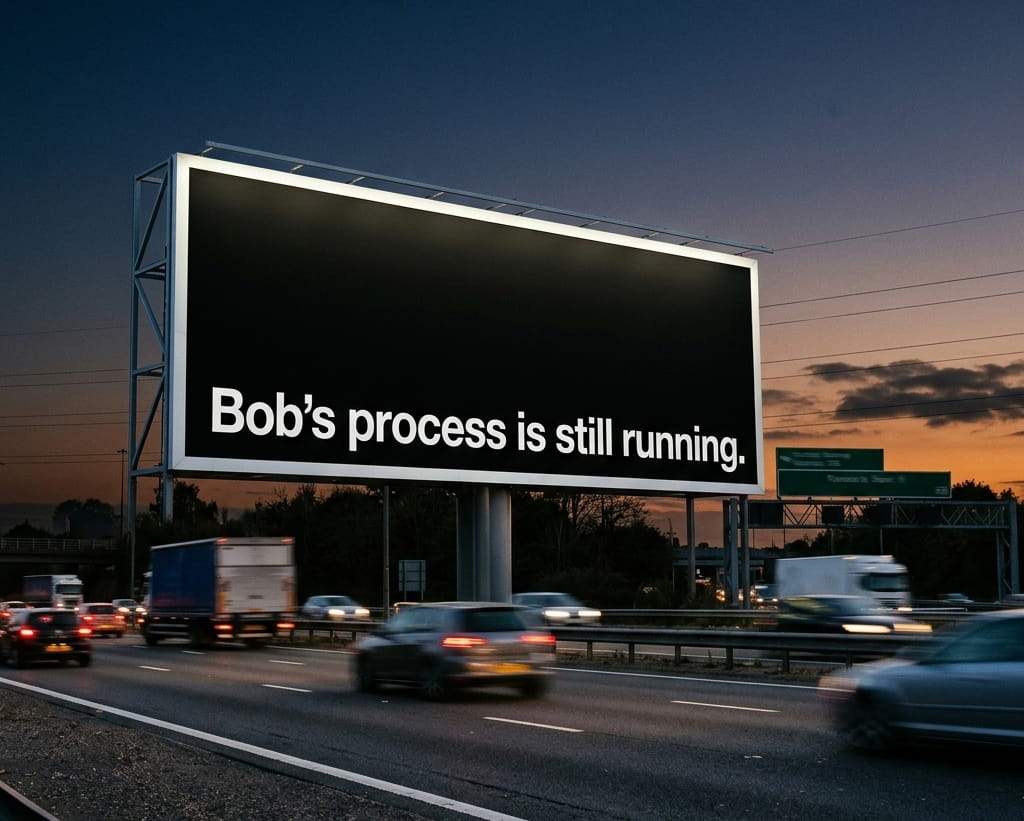
It’s usually nobody’s fault. There was no initial resource for marketing, so this SOP has been followed week in, week out for the past nine years since Bob wrote it and retired.
Bob’s process is still running.
The gap between what businesses think their marketing is doing and what it’s actually achieving can be massive.
Most of these businesses running like this have not tracked any real data. Ever.
It’s like running into a warzone, firing a machine gun with a blindfold on. Sure, you might hit something, but it’s 50/50 whether you’ll shoot one of your own.
What Proper Tracking Actually Exposes
When we implement proper tracking and measurement, the first thing that gets exposed is traffic quality.
Organic traffic is much lower than expected. Search terms are mostly branded, people already looking for that business. The bounce rate is ridiculous.
Almost 20% of marketers cite adopting a data-driven marketing strategy as one of their biggest challenges in 2026. The paradox: organisations have more data than ever, yet confidence in measurement is declining.
If you don’t track content, you’ll never know what people want to engage with.
And you’ll just create rubbish.
The Systems That Come Pre-Built
Outsourced departments provide established frameworks, tools, and processes from day one.
Immediately, we take control of tracking. We install real conversion data layers on the site with Google Tag Manager and push that into GA4. When we start to curate content, we have a much better grasp on what content gets people to further their journey, to make a purchase, submit an enquiry, search for directions and so on.
We build the measurement infrastructure first, before creating anything.
Around 92% of marketers now use automation for data analysis and reporting. It’s become infrastructure, not emerging technology. Yet proper tracking implementation remains the exception, not the norm.
At first, if tracking has been neglected, we find trends in more general searches to create content for. Once we have enough data to analyse, we identify what’s driving the most engagement and conversion, then cluster content around those areas.
It becomes a compounding system. Data informs content, which generates more data, which refines the strategy.
The Capability Gap In-House Teams Can’t Close
I’ve worked in in-house marketing. It’s often much more reactive than data-driven.
Maybe that’s required at times. But it’s easy to spend considerable time on marketing strategy, only to never follow the plan due to reactive marketing “needs.”
Research shows marketers spend over 60% of their time on low-value or unnecessary tasks. More than half waste too much time trying to find content assets that may or may not exist.
Over 50% of a marketing team’s time is typically spent on repetitive tasks requiring no human intelligence.
The strategy exists. It just never gets executed.
Urgent requests keep coming in. The in-house person is constantly firefighting instead of building systematic growth.
Why Boundaries Actually Matter
An outsourced marketing service has total clarity on what their function is and what their goals are.
Clients understand that. The boundary is respected because it’s clear.
“They’re the marketing team. They don’t care that John needs to get this used car delivered to the customer today and the delivery driver is off sick.”
When you’re in-house, particularly in smaller teams, roles naturally get blurred. You end up doing multiple things. Just the way of the world.
That’s the benefit of outsourcing. The line is clear. So is the goal. So is the task at hand.
The outsourced team stays focused on growth whilst the in-house person ends up sorting John’s car delivery.
What Businesses Get Wrong About The Decision
Businesses make assumptions about what they need before a marketing professional analyses it.
An example: a business thinks “we need SEO.” It’s a valid thought. SEO is important in most businesses.
But if that business sells something with a target market of 18-20 year olds? Say smoothie bowls, and they’ve got a strong following on Instagram and TikTok, there are other marketing areas they should focus on first.
That might be an obvious example, but the pattern holds.
It’s important to understand business goals and customers before any marketing agency can recommend what will truly move the needle.
Companies see 3-5x returns on investment within 12-18 months when implementing strategic outsourced marketing. Early-stage companies achieve 40-60% cost savings compared to building internal teams.
Speed to market improves by 60-90% when using experienced external teams versus hiring and training internally.
The Infrastructure You’re Actually Buying
Outsourcing isn’t cost-cutting. It’s infrastructure investment.
You’re accessing integrated expertise, established systems, and scalable execution that in-house teams struggle to build from scratch.
Businesses save 25-30% on operating expenses through outsourced marketing methods. Outsourcing achieves up to 43% higher ROI than in-house approaches because outsourced teams are already trained, equipped, and experienced.
Marketing automation delivers an average £5.44 ROI per £1 invested. Automated email campaigns convert at 2,361% higher rates than broadcast sends.
Automated email workflows represent only 2% of total email sends yet drive 41% of total email orders. That ratio represents the clearest statistical case for automation in email marketing.
That’s the advantage of systems that compound.
You’re not just hiring people to execute tasks. You’re accessing infrastructure that improves without linear input.
The measurement frameworks are already built. The conversion architecture is proven. The workflow automation is established.
Around 61% of marketers expect automation to become their largest marketing expense category by 2027. The shift towards systematic capability building is already happening.
What Actually Needs To Happen
Stop treating marketing as a hiring decision. Start treating it as an infrastructure decision.
The question isn’t “Should we hire someone or outsource?” The question is “What systems do we need to create compounding growth?”
If you can build comprehensive marketing capability in-house without the £60,000+ upfront cost, the months-long ramp-up time, the recruitment burden, and the legal complexity of underperformance, do it.
Most businesses can’t.
That’s not a weakness. That’s just resource allocation.
At PlugIt Studio, we build marketing infrastructure that works from day one. Proper tracking. Conversion-focused content. Automated workflows that run in the background.
Systems that improve without constant manual input.
If you’re tired of Bob’s nine-year-old email SOP and ready to build marketing infrastructure that actually compounds, let’s talk.
We’ll walk through exactly what your business needs, what will move the needle, and how the systems connect.
No blindfolds. No guesswork. Just infrastructure that works.