

Your website converts at 5%. You’ve A/B tested the buttons. Tweaked the headlines. Simplified the forms.
But 60% of your enquiries still vanish before they reach a salesperson.
We see this pattern constantly. Businesses obsess over website conversion rates whilst haemorrhaging revenue through broken handoffs, manual follow-ups, and disconnected systems. They’ve optimised the front door whilst the back office operates like it’s 2005.
The problem isn’t your website. It’s what happens after someone converts.
The Conversion Rate Illusion
Most businesses measure success at the wrong point. They celebrate a 5% form completion rate without tracking what happens next.
Here’s what actually happens in businesses without automated handoffs:
Someone fills out your form. The enquiry lands in an email inbox. An admin manually copies the data into a CRM. Or worse, into Excel, field by field. Eventually, someone assigns it to a salesperson. Maybe.
The industry average response time? 42 hours for B2B businesses.
By then, 78% of customers have already bought from whoever responded first.
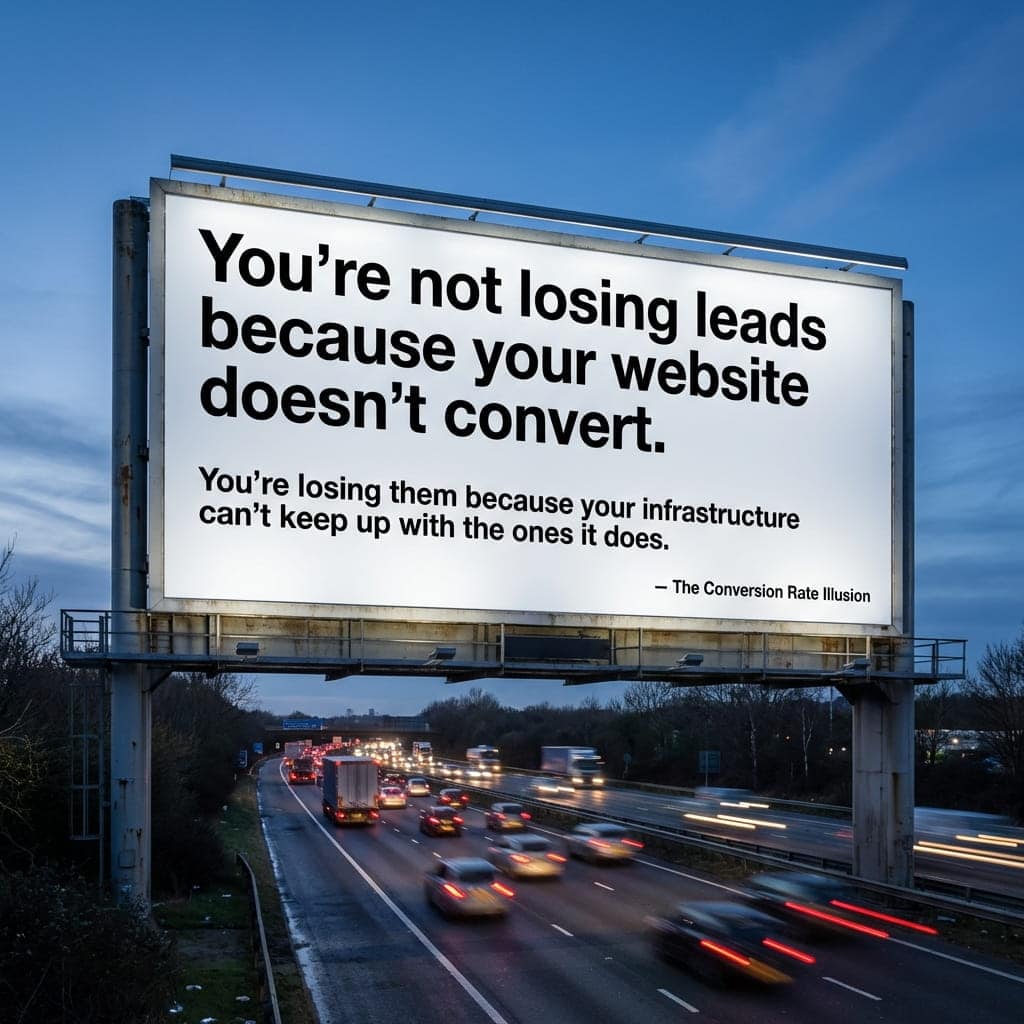
You’re not losing leads because your website doesn’t convert. You’re losing them because your infrastructure can’t handle the ones it does convert.
Where Revenue Actually Leaks
We use tools like Hotjar to watch what happens in real time. Heat maps. Session recordings. Drop-off points.
The pattern is consistent: businesses overcomplicate the journey.
Too many form fields. Too many buttons on one page. Too many questions that feel intrusive before trust is established. People don’t want to answer ten questions just to get a quote. They’re evaluating you against competitors who ask for three.
But even when you fix the form, the real friction starts after submission.
Take finance leads. Without automation, here’s the manual sequence:
- Lead submits form
- Email notification sent
- Admin opens email
- Admin manually enters data into CRM
- Admin assigns lead to available broker
- Broker receives notification (eventually)
- Broker manually follows up (if they remember)
Each handoff adds friction. Each manual step introduces delay. Each delay reduces conversion probability.
Research shows you’re 100 times more likely to connect with a lead if you respond within 5 minutes compared to waiting an hour. Respond within one minute? Conversion rates jump 391%.
Manual processes make speed impossible.
The Handoff Tax
Manual lead assignment costs 5-15 minutes of dead time before a rep even sees the enquiry. That kills the critical first-five-minute window when leads are most responsive.
But time isn’t the only cost.
In sales offices, manual assignment creates politics. “That’s my deal” mentality. Territory disputes. Leads sitting in limbo whilst reps argue over ownership.
Worse: over 30% of leads are never contacted at all when businesses rely on manual follow-up systems. Sales reps typically make just 1.3 call attempts before giving up.
You’re not just losing speed. You’re losing enquiries entirely.
One analysis found more than £2.7 billion in conversion opportunity for leading eCommerce brands simply by identifying friction in their digital experience. For SaaS businesses, checkout friction alone costs millions annually.
This isn’t theoretical. It’s measurable revenue leaking out of broken handoffs.
Infrastructure Before Optimisation
Most agencies start by optimising the website. They’ll tweak your landing page for months before addressing the fact that your CRM doesn’t talk to your website.
We do it backwards. Build the infrastructure first. Automate the handoffs. Then optimise.
Here’s why sequence matters:
If you optimise a website that feeds into a broken backend, you’re just driving more leads into a system that can’t handle them. You’ll increase form submissions by 20% and watch 60% of them disappear into manual processes.
But if you automate first, every optimisation compounds. A 20% increase in form submissions translates to 20% more enquiries in your CRM, instantly assigned, immediately followed up, systematically nurtured.
Automation creates the foundation for optimisation to actually work.
The Three-Layer Conversion Engine
We structure client work around how systems actually function:
01. Build
Connect your website to your CRM. Route enquiries based on business logic, broker preference, territory, product type. Eliminate manual data entry entirely.
02. Automate
Set up SMS and email sequences that fire immediately after form submission. Nurture leads whilst your team prepares to contact them. Remove the dead time between enquiry and first touch.
03. Optimise
Now, and only now, start testing. Simplify forms. Reduce button count. A/B test headlines. Every improvement feeds into a system that can actually handle the increased volume.
This isn’t a service menu. It’s structural logic. You can’t optimise what isn’t built properly. You can’t scale what isn’t automated.
What Integrated Systems Actually Deliver
When you treat the customer journey as one conversion engine instead of fragmented touchpoints, the results compound:
Speed to contact drops from hours to seconds. Leads receive confirmation instantly. Your team gets notified immediately. First contact happens whilst the enquiry is still warm.
Follow-up becomes systematic, not sporadic. Automated sequences ensure every lead gets contacted. No enquiries slip through gaps. No manual reminder systems required.
Office politics disappear. Leads route automatically based on predefined rules. No disputes over ownership. No manual assignment decisions.
Conversion velocity increases. Businesses using automated lead follow-up systems reduce response times by 30% and boost conversion rates by 25%. The advantage isn’t marginal, it’s structural.
We’ve seen clients achieve 40%+ improvement in pipeline conversion simply by automating the handoff between website and CRM. Same website. Same offer. Different infrastructure.
Implementation Hierarchy
If you’re running manual processes between your website and your sales team, here’s the sequence that works:
Map the current journey. Identify every handoff point. Track how long each manual step takes. Calculate how many enquiries drop off at each stage.
Connect your systems. Integrate your website forms directly into your CRM. Eliminate email as a middleman. Remove manual data entry entirely.
Automate the immediate response. Set up confirmation emails and SMS messages that fire on form submission. Let leads know their enquiry was received whilst they’re still on your site.
Build the nurture sequence. Create automated follow-ups that keep leads warm whilst your team prepares to contact them. Remove the dead time between enquiry and first conversation.
Then optimise the front end. Simplify your forms. Reduce friction points. Test different approaches. Now your improvements actually translate to pipeline growth.
The order isn’t arbitrary. It’s structural.
Stop Optimising in Isolation
Your website is one touchpoint in a system. Optimising it in isolation creates a false ceiling.
You’ll hit 5% conversion and plateau. Not because your website can’t perform better, but because your infrastructure can’t handle what it already produces.
The businesses that grow systematically treat their customer journey as one integrated conversion engine. They build infrastructure that removes friction at every handoff. They automate processes that used to require manual intervention. They optimise once the foundation can support it.
That’s not a service offering. That’s how systems work.
If you’re still manually copying enquiries from email into Excel, you’re not losing leads because your website doesn’t convert. You’re losing them because your infrastructure can’t keep up with the ones it does.
Fix the engine. Then optimise the front door.
Build Infrastructure That Actually Converts
If your enquiries are still moving through manual handoffs, you’re losing revenue every day.
We build conversion engines that connect your website, CRM, and sales process into one automated system. No busywork. No dropped leads. No manual data entry.
Book a consultation to map your customer journey and identify where you’re haemorrhaging enquiries.